The emptiness and the lightning
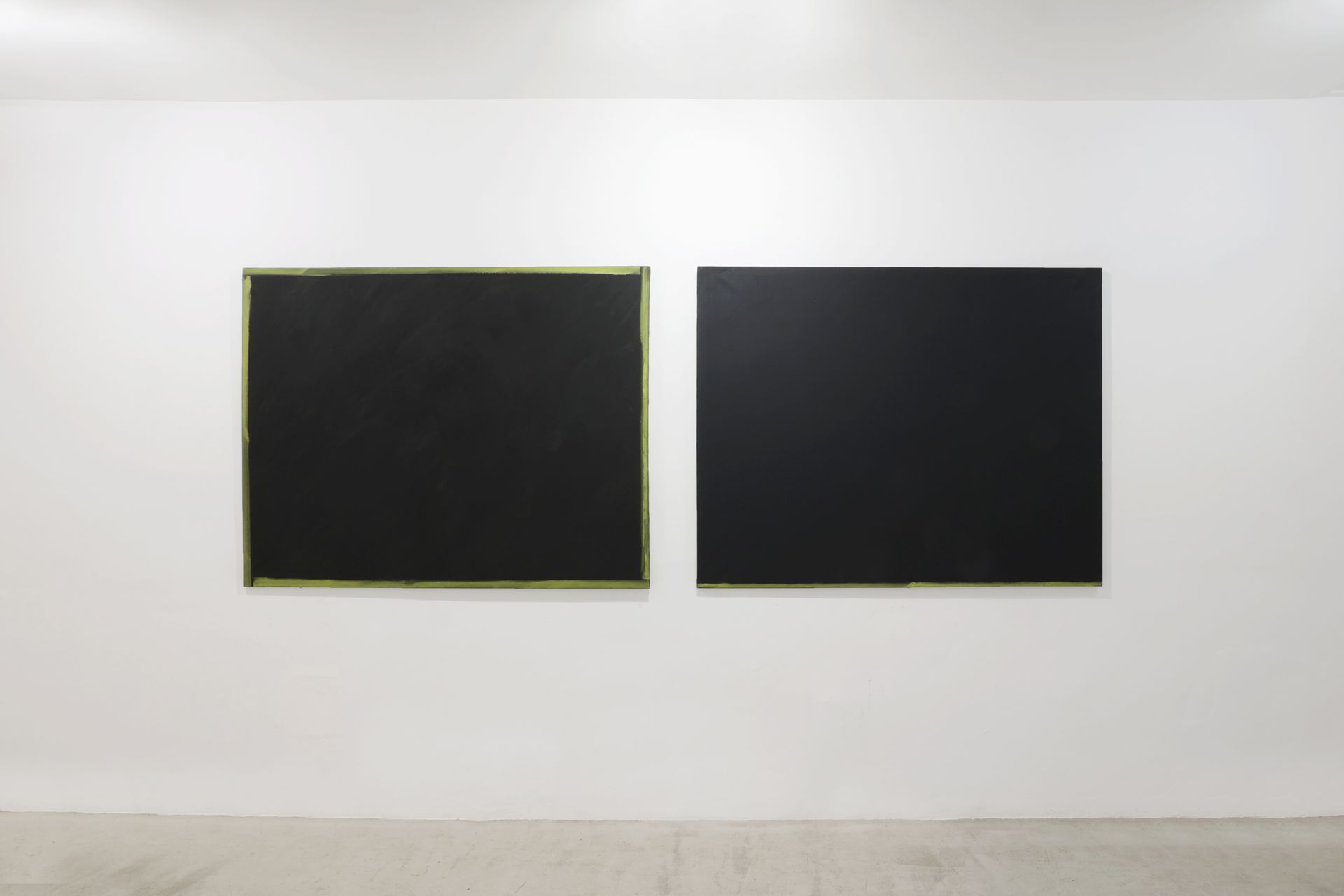
Alfons Borrell painted the diptych 15-22.XI.78 in the mid-1970s, a moment when his painting became consolidated by simplifying form and colour to reach a very radical abstraction. In 1976, he decided to title his works with the date of their completion. Articulated by two dark square forms, it indicates the direction Borrell will take in his painting: the square, which occupies a central place, and the use of colour, regarded not as a quality of the object, but as a subject in itself. A colour that fluctuates and moves, leaves the frame and invades everything. In Borrell’s chromatic palette, orange has a prominent place, but also green, blue, red, pink and black. In 15-22.XI.78, he doubles the presence of the square and opts for black. More than forms closed in on themselves, Borrell’s geometries display a constant movement of opening or overflowing and folding, as if they want to delimit space, both physical and meditative. A year after painting this diptych, his friend Joan Brossa wrote of Borrell: ‘He paints emptiness and lightning; sometimes he raises his ear to the cliff of echoes and sketches silence or hides the storm in a scheme of vibrations.’
Works in the Collection


artist

Since his first solo exhibitions in the late fifties, Borrell’s work has been presented in major art spaces in Spain, France, Germany, the United States and Japan. The art critic Alexandre Cirici invited him to be part of the inaugural exhibition of the first Museu d’Art Contemporani de Barcelona, above the Coliseum Cinema in 1960. In 1978, he took part in the exhibition Seny i rauxa. 11 artistes catalans at the Centre Georges Pompidou, Paris. Retrospective exhibitions of his work include those held at the Centre Cultural Tecla Sala, Hospitalet de Llobregat (2006), Museu d’Art de Sabadell (2007) and Fundació Joan Miró, Barcelona (2015).
MACBA Thirty
We celebrate Year Thirty of an infinite MACBA that projects the future as a space for revision and possibility: of taking up what was left unfinished, updating what needs it and projecting anew everything that can still be transformed.