Jordi Benito, ABRUPT and Disturbing

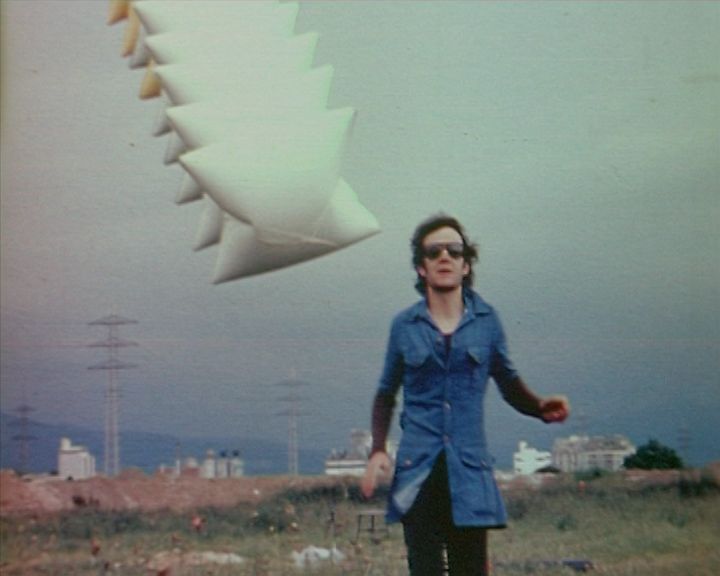
One of the most radical Conceptual artists in our country, Jordi Benito bequeathed us some abrupt and ceremonial performances that still resonate today. Fascinated by Viennese Actionism and Wagner’s idea of the ‘total work of art’, he turned his own body into a field of action akin to the liturgy of Romantic drama. A practice that began in the early 1970s with more intimate actions, yet soon evolved toward rituality and revelation. Sch-ptp, from 1979, is representative of one of the most intense periods in this Catalan artist. A performance featuring animal carcasses from a slaughterhouse that took place at the Remont Gallery in Warsaw, responsible for introducing Action art into Poland. That same year, Benito had taken part in the Performance Festival in Lyon and, a few months later, performed his radical Barcelona Toro Performance at the Fundació Joan Miró, Barcelona. As in other works of this period, Sch-ptp was carefully choreographed, with intense lighting emphasising the colours of the materials, atmospheric music, the presence of blood and the agency of the artist orchestrating the performance.
Works in the collection


artist

Benito began a line of work that lasted until the eighties and nineties with performances of great theatricality in which painting, music and ritual sacrifice strive to become a complete artwork. One of his most controversial actions was Barcelona Toro Performance at the Fundació Joan Miró in 1979, where he sacrificed a bull. In 1979, in another action at the Centre Pompidou, he used a dead body in a provocative performance that foreshadowed the work of Damien Hirst. In his rituals, Benito dismembered animals and used blood as an artistic element. Music was an essential component: he was particularly fond of Wagner and collaborated with musicians and composers such as Carles Santos and Agustí Fernández. After a period of artistic inactivity, in the early 2000s he began making installations with light, pianos and mathematical formulas. His last intervention took place in the concourse of the Provença station of the Ferrocarrils de la Generalitat de Catalunya, in a homage to Pompeu Fabra, the author of the normative reform of the Catalan language. Benito was one of the most significant representatives of body art in Spain. Art, for him, was intrinsically linked to life.
Jordi Benito performed his actions and held exhibitions at the Museu de Mataró (1976); Centre Pompidou, Paris (1978); Fundació Joan Miró, Barcelona (1979 and 1984); Museu de Granollers (1984, 1995 and 2003); MNAC, Barcelona (1995); Museo Nacional Centro de Arte Reina Sofía, Madrid (2005); Museum Kunst Palast, Düsseldorf (2006); and Museo d’Arte Contemporanea, Rome (2007). He also exhibited in galleries and spaces in Catalan towns such as Cadaqués, Mataró, Terrassa and Reus, as well as in Spanish cities such as Madrid, Zaragoza, Seville and Valencia, and other European cities including Arles, Dijon, Nantes and Lisbon, among others. He participated in Documenta 5, Kassel (1972); Paris Biennale (1975); and the Lyon Performance Festival (1979). His work is included in the collections of MACBA, Museu de Granollers and Metronom-Fundació Rafael Tous d’Art Contemporani.
MACBA Thirty
We celebrate Year Thirty of an infinite MACBA that projects the future as a space for revision and possibility: of taking up what was left unfinished, updating what needs it and projecting anew everything that can still be transformed.