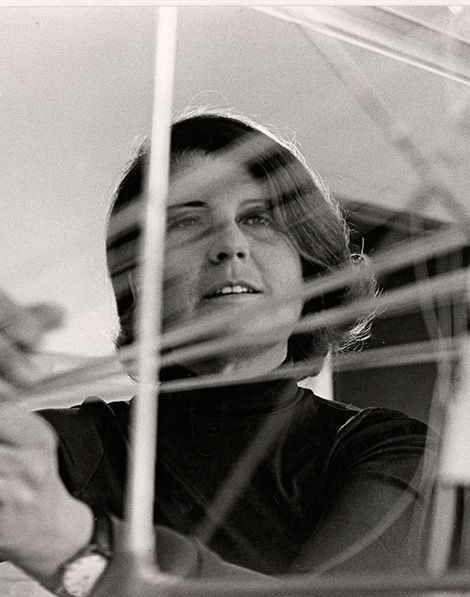
Following her studies at the Escola d'Arts Aplicades (School of Applied Arts) and at the Escola Massana in Barcelona, Aurèlia Muñoz dedicated herself to the research and exploration of contemporary textile art, a field in which she soon became an international benchmark. Around 1960, she painted her first work on hessian, which subsequently acted as a trigger. Interested in the symbolic simplicity of the Romanesque and the rhythmic poetics of artists such as Paul Klee, for a few years she continued painting on hessian, while also making embroidery with hand-dyed wool. In the mid-seventies, she discovered macramé and other ancient knotting techniques, such as those used by fishermen in Blanes. In those years, Muñoz started to find her own language. She began exploring three-dimensionality and monumentality, her tapestries abandoning the mimicry of painting and the wall, and becoming fully autonomous. Now free from the threads and roots that anchored them to the ground, they took on verticality until they became beings suspended in the air. It is at that time, in the mid-seventies, that her emblematic winged forms of birds and kites began to appear, together with her work using the form of the book. By this time, her production was fully conceptual, incorporating new materials such as canvas and sails supported by metal structures. In her last years, the artist worked with handmade paper to create mobiles and three-dimensional forms.
Initially included in the so-called Nouvelle Tapisserie and the Catalan Tapestry School, from the mid-sixties she participated in the Lausanne International Tapestry Biennials (1965, 1969, 1971, 1973, 1977 and 1983) and in the first international exhibition of artistic textiles at the Museo Español de Arte Contemporáneo in Madrid (1969). Following which, she participated in events such as the São Paulo Biennial (1973), Fiber Works, Kyoto (1976), Venice Biennale (1978), and group shows at the Art Institute of Chicago (1999), Château d'Ansembourg, Luxembourg (2001-03), Museum of Modern Art, New York (2019), CentroCentro, Madrid (2021) and the Guggenheim Museum, Bilbao (2021), among many others. Solo exhibitions have been held at the Museo de Bellas Artes, Bilbao (1990) and Museu Nacional d'Art de Catalunya, Barcelona (2019). In 2026, a major retrospective titled Aurèlia Muñoz. Beings is being held at the Museo Nacional Centro de Arte Reina Sofía, Madrid, and MACBA, Barcelona. Muñoz's work is included in numerous collections around the world, such as the National Museum of Modern Art, Kyoto; Stedelijk Museum, Amsterdam; Royal Scottish Museum, Edinburgh; Fundación Juan March, Madrid; and MACBA, Barcelona.
To consider: we document the MACBA Collection through detailed research. In the event that there are any mistakes, we would appreciate being notified.
works


